










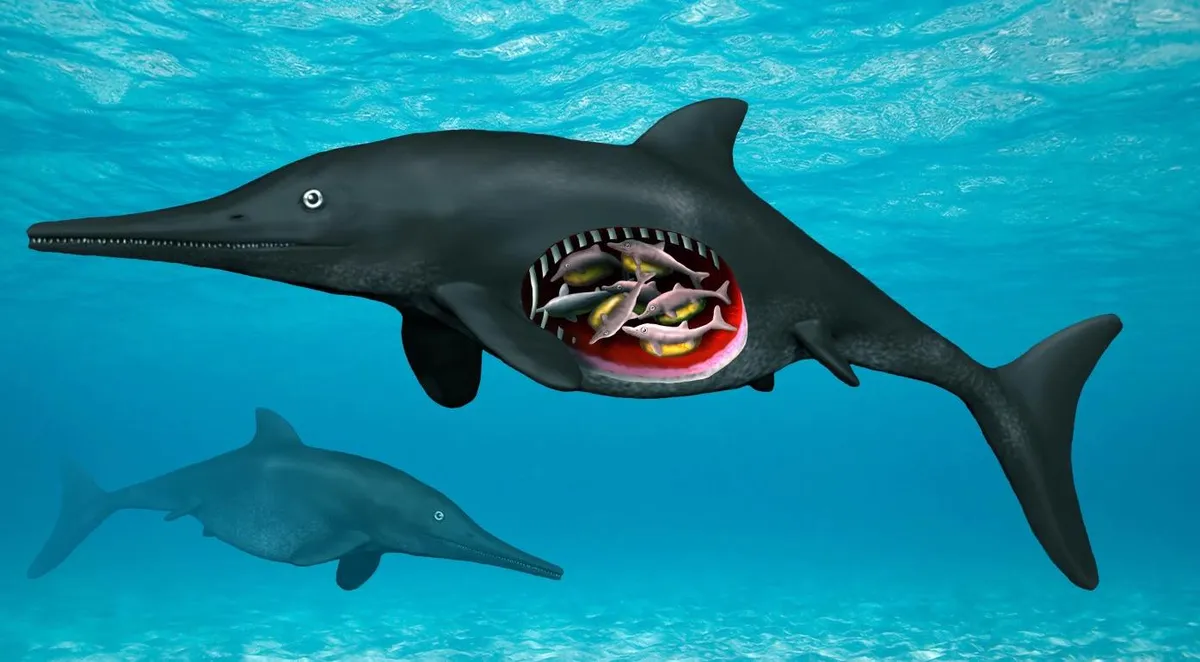
The discovery of a 180-million-year-old ichthyosaur fossil in Mistelgau, Germany, raises important questions about its survival and feeding adaptations. This specimen, belonging to the genus Temnodontosaurus, measures approximately 21 feet in length and includes a nearly complete skull, lower jaw, shoulder girdle, spine, and more than 100 teeth.
The fossil shows signs of severe jaw injuries that likely limited the animal’s ability to catch prey. Stefan Eggmaier, a researcher involved in the study, stated, “The fact that it nevertheless survived is evidenced, among other things, by its heavily worn teeth and gastroliths, which we were able to identify in the abdominal region.” The presence of gastroliths—stomach stones—suggests a shift in feeding behavior.
This discovery challenges previous assumptions about the survival timeline of ichthyosaurs in the region. Ulrike Albert noted that their Temnodontosaurus fossil is one of the youngest finds of this ichthyosaur genus to date. The fossil provides insights into the ecological dynamics of Jurassic seas and highlights the complexities of prehistoric survival within marine ecosystems.
Ichthyosaurs resemble modern-day dolphins but are not directly related to them. This finding contributes to our understanding of convergent evolution among marine reptiles during the Mesozoic era. The Mistelgau site has been a rich source of marine fossils since excavations began in 1998.
Researchers emphasize that further study is necessary to fully understand the implications of this find on our knowledge of Jurassic period marine life. As excavations continue at Mistelgau, scientists hope to uncover more fossils that could shed light on ancient marine ecosystems.